Different Ways Of Knowing

Editor’s Note: It is often the case that people give words to events, and I feel spoken for by their words. Regular readers of Dark Matter will know that Lynne McFarland does this for me a lot. Here’s Lynne doing that again. I welcome your thoughts.
I’ve been thinking about how we humans enjoy different ways of knowing, as if we-- as if the mind and body-- were playing around with truth, coming at it from different angles.
Kant was on to some of this: You’ve got your logic and math, analytic truths that are indisputable if you have the terms right. We’ve got scientific truths that depend on methods we have fine-tuned, moral truths that basically depend on whether we could wish a particular conclusion on the whole world, and judgment, a kind of skill in considering what is before us.
Then there’s knowing as a long, breathtaking story of what us humans have been up to over time, flags planted along the way, and then the reactions to that long story, like Kierkegaard’s observation that Hegel built a palace but lived in the doghouse next door.
And then various accounts that begin with existence, our lived-experience, and what is it to be the sort of being that is a human being. What is given, and what one chooses.
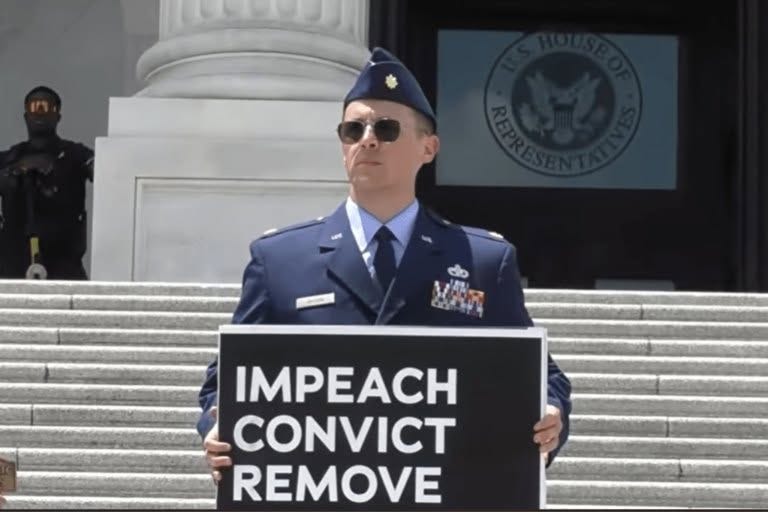
Today, thanks to AF Major Jason Watson, I am thinking of one way of knowing that is not unique to the Major, but which he just demonstrated: truth as something you must do, and action as being at home in both your body and mind.
Like I say, this kind of knowing is not unique to Major Watson. Our histories give us examples of this kind of knowing. I think of Martin Luther, M. Gandhi, Dr. King, The Freedom Riders who wrote their wills, and closer to home, individuals I know who daily choose to show up, who live nonviolently, practice resolving conflicts by addressing the conditions rather than by attacking other people, and see the divine spark in each person (including themselves).
It was a hot day, he was in full dress uniform, he had thought it through and made his own sign; he was at home in the world. The consequences were gonna be what they were gonna be, and that was ok. He appeared at ease. He kept his shades on.
He said in the grand scheme of things he was a nobody –but that words and action meant something. His action demonstrated a particular kind of truth that emerges from a particular kind of knowing: Truth that resides in each of us like a drawstring that pulls our disparate parts together into being.
This drawing together into being is a kind of revelation that invites witnesses to, well, to witness. Something is revealed in this, and yet also, if we are honest about it, something remains undisclosed. This is the sort of being that we humans, in our embodied existence, are capable of.
Each of us is both a nobody, as Major Watson called himself, just a single human being, but also, in bringing one’s full being to bear, in action, and indeed feeling unable to do otherwise, each of us is a shining present, a truth that mysteriously and humbly manifests, and which may make a difference when it counts.
btw, here is a link to an interview that Major Watson did with Jessica Denson beforehand in which he talks about the process that led him to take his action; it is long but illuminating.
Thank you, David.
My mind flew back to Olympia Dukakis in Moonstruck, when asked to cross a moral line, she said no, and her reason was simply "I know who I am."