The Great Beast

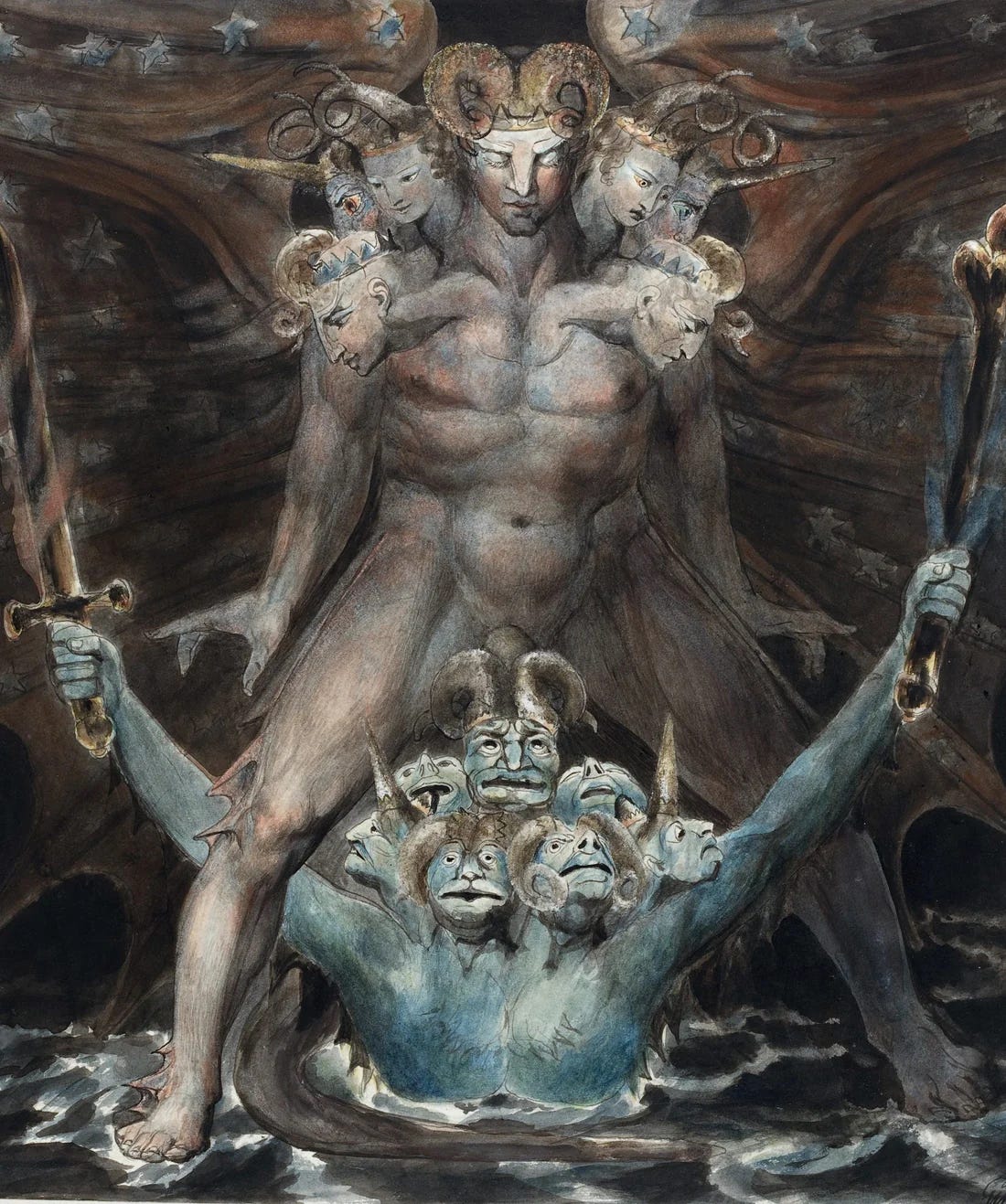
Brian Phillips speaking of the “entity” has me thinking about Simone Weil on “the Great Beast.”
Here’s Simone Weil on the Great Beast:
The Great Beast is the only object of idolatry…the only imitation of something which is infinitely far from me and which is I myself…Only one thing can be taken as an end, for in relation to the human person it possesses a kind of transcendence: this is the collective. The collective is the object of all idolatry…Rome is the Great Beast of atheism and materialism, adoring nothing but itself. Israel is the Great Beast of religion. Neither the one nor the other is likable. The Great Beast is always repulsive…The whole of Marxism, in so far as it is true, is contained in the page of Plato on the Great Beast…The power of the social element. Agreement between several men brings with it a feeling of reality. It brings with it also a sense of duty. Divergence, where this agreement is concerned, appears as a sin…The state of conformity is an imitation of grace…The service of the false God (of the social Beast under whatever form it may be) purifies evil by eliminating its horror. Nothing seems evil to those who serve it except failure in its service.
The part of me that wants to leave the passage and the image provided by William Blake alone on the Internet to speak for themselves is, at this moment, overcome by the part that wishes to offer comment. Before reading my commentary, please read Simone Weil’s words again and consider applying them to your particular context(s).
When I try to apply them to mine, I hover over that last part: Nothing seems evil to those who serve it. I don’t imagine hardly anyone sets out to serve evil. But then, there are the arrangements into which we are born and within which we survive and try to thrive and look out for ourselves. These arrangements—agreed upon between people—take on the feeling of reality, and, before we know it, we’re defending them as if they are, in themselves, persons rather than arrangements, sometimes alarmingly arbitrary, between persons. Rome and Israel, Weil reminds us, started out as arrangements agreed upon by vulnerable migrants. By story and song and inscription, they each took on an aura but remain arrangements. The conformity and compliance demanded by such arrangements are an imitation of grace. When we start imagining any arrangement rightly necessitates visiting bodily harm or death upon persons, we have succumbed to idolatry, the Great Beast, and, needless to say, evil.
I don’t know your context(s). My mind turns to children in Tehran and Americans enlisted in Kuwait. I think of my U.S. Navy sinking the IRIS Dena and the fate of its crewmembers. I think too of Senator Tim Sheehy’s decision to assault Marine Corps veteran Brian McGinnis as he exercised his certain inalienable right to speak up in public and on camera. Something less than persons possesses persons asserting they’re defending persons as they terrorize persons. What possesses a person to order—or sanction or normalize or make excuses for—the wounding or drowning or burning alive of other persons? Idolatry. There’s money in it.

I don’t think of a person being possessed by something less than a person as a rare occurrence among persons. I am, myself, often possessed by and even act upon feelings which get me into trouble and which, upon examination, were not, in fact, grounded in reality. False gods are tricky like that. I get to remind myself that a feeling, no matter how powerful, is always something less than a person. To be possessed by idolatry—or idolatrous feelings—is to forget this. Weil speaks of a feeling of reality that gets hold of people and pulls them into very dark corners. They do and say and play along with things unworthy of their best, deepest selves. In such instances, our minds are so darkened that our capacity for truth—for even wanting to know what’s true—is diminished. Weil has a disturbing saying for this form of debasement: “Evil, when we are in its power, is not felt as evil, but as a necessity, even a duty.”

I recently found myself thinking of particular people in my life as “post-truth people.” To do that is useful to a point. In e-mails, private messages, hallways, and sidewalks, I encounter people who are, in their current positioning of themselves, effectively post-truth. When confronted with what’s true, they cannot be counted upon to acknowledge it or to adjust, correct, or revise their testimonies or takes to fit available reality. Circling back toward lived truthfulness appears to be, for them, too costly at this time. The apparent power they feel in not circling back, staying stuck, and doubling down in lived denial (Access, association, protection) is not to be surrendered. In this sense, they are, for now, unsafe people posing a threat to themselves and others.
But those who dwell in darkness are more than the sum of their bad choices. Nobody’s just a post-truth person. There’s always a story that got each of us wherever it is we each of us are right now. Bruce Cockburn’s words are a help to me as my feelings about others get all bunched up: “If somebody chooses to align themselves with darkness, it doesn’t come out of nowhere. There’s a reason that they’re doing that. It doesn’t mean that we have to tolerate their actions, but I think we should try to communicate and to confront each other with respect…You have to have that. Otherwise, you’re just surrendering to the chaos.”
Cockburn says “chaos.” Weil says “the Great Beast.” I say empire. Let’s not surrender to its many manifestations.
In our crisis of disconnection, let’s manifest a counterwitness to the chaos. Amid disintegration, avenues of integration remain open to us in our myriad contexts. I borrow the phrase “crisis of disconnection” from Craig Bamford who dropped the phrase in his characterization of The Rural School of Arts & The People’s Forest. Perhaps there are as many crises of disconnection as there are people in the world. But there are just as many avenues to connection, to art and artfulness—the healing game—amid the chaos. In fact, there are more.
To move toward integration starts with examining my own self (breathing, feeling, thinking) with curiosity and compassion. The compassion part, though, has to be extended to others if I’m going to feel it in my own bones. This is where Cockburn’s counsel intersects with a challenge issued by bell hooks in the form of a question: “How do we hold people accountable for wrongdoing and yet at the same time remain in touch with their humanity enough to believe in their capacity to be transformed?”
That right there is the tension, the holding of space in the radical center. I find the image of the Great Beast helpful in the work of addressing the wrongdoing of others without losing touch with their humanity. When I do lose touch with it, I lose touch with my own humanity too.
In a very deep sense, we all know what’s wrong. The Great Beast is loud as hell. What are we to do? Reader, I am not always sure. But I have a few suggestions.

If you’re like me, you have—in addition to state and local officials allegedly representing your interests—two U.S. Senators and a House Representative over whom you have custody. Put their numbers on your phone and call them. I never get through to them personally, but I’ve developed something of a rapport with some of the folks I pay to take my calls. You can speak to them while walking or doing other things. I know I’m not speaking to the Great Beast when I get personal with a person.
You can also show up for folks being detained, deported, or tortured. The image above is me (with others) standing alongside the family of Kilmar Abrego Garcia last summer. Do you remember him? The entire Trump Cabinet lined up against him. I’m sure they aren’t done trying to terrorize him, but…at least for now…he’s back with his family.
One can also start with available connectedness. If you have one person you admire and with whom you feel connected, check in and let them know the gift they are to you. If you admire them and feel disconnected from them, perhaps now is a good time to reach out. Circle back with the real ones.
There’s more than one way to give voice to what bothers you. Mother Ann Lee is said to have said, “Every force evolves a form.” Sit with the feelings, feel their force, give them a form. There are so many ways to bear witness, so many ways to access and even enjoy our own moral power, so many ways to not give in to fear. So many ways to inconvenience empire’s hirelings and invite them to rethink their positioning. So many ways to stand up and make the right kind of noise. So many ways to stay human.
Editor’s note: The top image is William Blake’s “The Great Red Dragon and the Beast from the Sea.” The second image is Marco Rubio commemorating Ash Wednesday while also normalizing tax-funded horror on camera. The third image, captured by Roberto Schmidt, is Pam Bondi refusing to look at survivors of the Epstein cabal.
Bravo, David.
David, your words have consistently been a gift to me.
I love your idea about calling and building a human connection with congressional staffers who answer the phones. The problem I have encountered is that I am so beyond frustrated (perhaps because I have been quiet for too long) that it is difficult for me to be as kind and thoughtful as I aspire to be once I actually get a live person on the phone.
On the rare occasions I have done so, I am tempted to take out all my frustrations with their boss on them and morally shame them for it all.
This is not helpful, and it’s not who I want to be. So I welcome any advice you have for dealing with this impulse. Because as it stands, I seem to lack the emotional maturity to make such calls. But I am not content to stay this way.